What is the future of smart food packaging systems? It is not only about adding sensors, QR codes, or connected labels. The stronger vision combines food safety, freshness monitoring, traceability, waste reduction, and practical consumer communication. A package may display a color change when temperature abuse occurs, record its cold-chain history, or guide shoppers toward better storage. Imagine opening a salad pack and seeing a freshness indicator beside clear recycling instructions. Small details matter.
Dr. Jean-Yves Paris, a food-packaging researcher, has stated, “The best packaging protects food, communicates clearly, and creates less environmental pressure.” This principle gives the discussion a useful foundation. Smart systems should serve measurable needs, not become expensive technology ornaments. They must work across factories, warehouses, retailers, and kitchens. They also need reliable data, readable signals, safe materials, and privacy-conscious digital tools. A connected package that confuses consumers has failed, even if its software is impressive.
The seven tips ahead examine practical decisions for this changing field. They consider sensor selection, active packaging, recyclable structures, supply-chain visibility, usability, cost, and verification. Real experience shows that adoption is rarely smooth. Sensors can drift. Labels can be ignored. Recycling claims can be misunderstood. Progress needs testing.
Not perfection.
The future will likely belong to systems that quietly prevent spoilage, explain product conditions, and support responsible purchasing. Yet important questions remain. Can smart features survive real distribution conditions? Can smaller producers afford them? Can consumers trust the information? These questions deserve honest attention before the industry calls packaging truly intelligent.
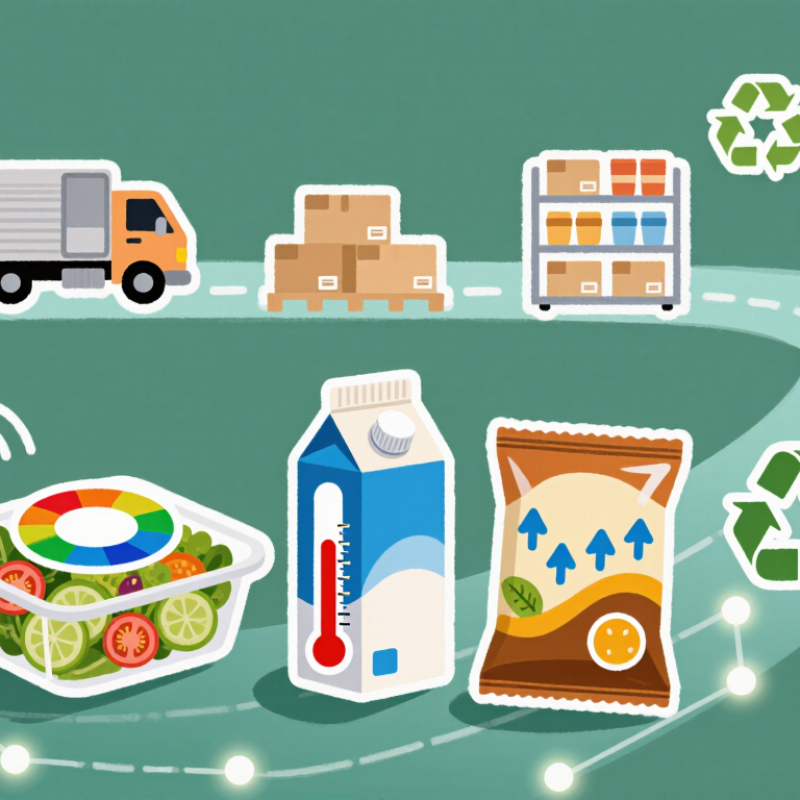
Smart food packaging systems use sensors, indicators, or digital links to communicate a product’s condition. They do more than contain food. They help people understand freshness, temperature exposure, authenticity, and handling history. The definition is useful, but not perfectly tidy. Some systems actively protect food, while others only report information.
Core functions usually include time-temperature monitoring, freshness indication, leak detection, and traceability. A small color panel may show whether chilled food faced excessive heat. A connected label can record movement through storage and transport. These details support better decisions at warehouses, stores, and kitchen counters. They also require clear instructions. Confusing signals create waste instead of reducing it.
Industry data shows why this field is developing. The MarketsandMarkets Smart Packaging report projects the market to reach about 52.5 billion US dollars by 2028, with food packaging among its major applications. The UNEP Food Waste Index Report 2024 estimates that 1.05 billion tonnes of food were wasted in 2022. Smart packaging cannot solve that problem alone. It may help identify avoidable spoilage, but sensor accuracy, recycling compatibility, and cost remain practical weaknesses. A beautiful digital feature is not automatically useful. Packaging engineers should test real storage conditions, not only laboratory samples.
Sensors can track temperature, humidity, oxygen, pH, time, package damage, and freshness signals. A temperature spike may reveal a broken cold chain. They show conditions, not guaranteed safety.
Start with temperature. A small device can flag exposure above the product’s safe range. Add humidity when condensation threatens leafy produce. More sensors are not always better.
Earlier alerts can support markdowns and safer stock rotation. A warehouse team may redirect a shipment before spoilage becomes visible. Sensors do not magically prevent waste.
Each package needs a scannable identity linked to batch history. Temperature readings need time, location, and product limits. A number without context can mislead.
Clear alerts should identify the shipment needing attention. Trained staff should check the package and storage records. Automation needs supervision. People still make mistakes.
No. Sensors monitor risk conditions, but validated microbiological testing remains necessary. A normal reading cannot prove that food is safe. This limitation is easy to forget.
Rough transport, long storage, weak connectivity, battery failure, and poor scanning can break the data trail. Calibration and regular checks are essential. Failure happens.
Begin with a small pilot around one clear risk. Measure accuracy, false alarms, missed warnings, response time, waste reduction, battery life, disposal impacts, and user adoption. Publish uncomfortable results too.
Smart food packaging systems combine advanced materials, sensors, and connected technologies to do more than protect food. Their core functions include monitoring temperature, humidity, freshness, and possible spoilage, helping consumers and suppliers make better decisions about food quality. By collecting real-time data, these packages can communicate important information throughout storage, transport, and retail, improving traceability and reducing unnecessary waste.
What is the future of smart food packaging systems? It is likely to involve intelligent, sustainable designs made from recyclable, biodegradable, or resource-efficient materials. Future systems must also balance convenience with safety, privacy, affordability, and regulatory compliance. Clear data practices, reliable sensor performance, and responsible material selection will be essential for public trust. Overall, smart packaging could support longer shelf life, safer food handling, and more efficient supply chains while contributing to environmental goals.

 Nexa Machine